Category: Human nutrient reuse

  • Kenyans safely recycle human excreta into fertilizer and help out Lake Victoria

    Kenyans safely recycle human excreta into fertilizer and help out Lake Victoria

    A team of entrepreneurs and researchers in Kisumu, Kenya is converting human excrement into biochar and creating a low-cost, local fertilizer. Through their work they hope to keep excess nutrients out of Lake Victoria, address food insecurity, and improve quality of life. In this recording of our Spring 2026 webinar, Cornell University Professor Rebecca Nelson, an expert on the Circular Bionutrient Economy, describes the project.

    The town of Kisumu, Kenya lies at the northeastern edge of Lake Victoria, the biggest lake in Africa and home of the earth’s largest freshwater fishing industry. The lake also provides water for agriculture, but high fertilizer costs and depleted soils prevent farmers from maximizing production. Meanwhile, excessive nutrients from informal settlements—communities without running water or sanitation—contribute to the harmful algal blooms in Lake Victoria that regularly kill thousands of fish.

    To solve the three-pronged problem of runaway nutrients, food insecurity and poor quality of life, local enterprises are partnering with nonprofits and scientists to find solutions.

    At the heart of the partnership is a farmers’ group called Kisumu Young Agripreneurs (KIYA) that has supported 500 farms and trained and mentored over 3500 youths. Roy Odawa, who heads up KIYA, works closely with an enterprise called Fresh Life, which provides and maintains 2,000 waterless, pee-and-poop-separating toilets in Nyalenda.

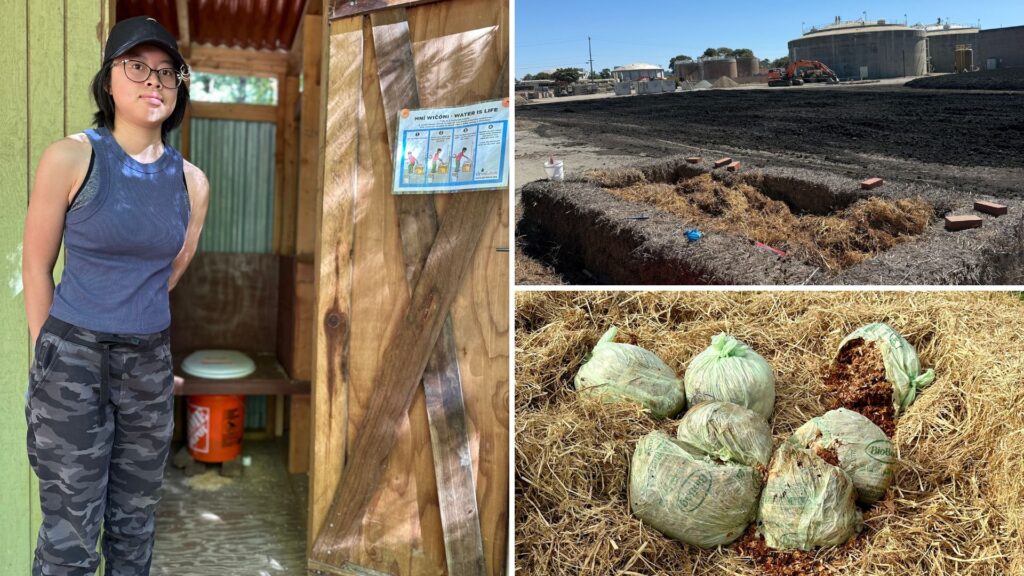
    One of Fresh Life’s 2,000 waterless toilets, which separate urine from feces. Photo: Rebecca Nelson

    Professors Nelson and Charles Midega, executive director at Poverty and Health Integrated Solutions in Kenya, are central to the project. Nelson teaches and conducts research at Cornell University that dovetails with this partnership in Kenya. “This is a dream come true for me,” she says. “Nyalenda is the most favorable place to do this work; every day we’re making progress.”

    Roy Odawa and Rebecca Nelson add human urine to biochar made from human excrement. Their goals? Locally made fertilizer and a cleaner Lake Victoria. Photo: Jon Miller

    To make the fertilizer, the team dries the feces on flat mats in a greenhouse. They mix these with wood chips and corn stalks or other crop waste, and heat the mixture to extremely high temperatures in a closed metal container to kill pathogens. The result is a porous, carbon-rich soil builder (similar to charcoal) that can absorb urine. Fresh Life has provided literally tons of human urine for the project and the team has figured out that adding magnesium to the urine will cause the phosphorus to precipitate. Now their partners can produce a beautiful granular fertilizer for crops that rivals commercial products.

    Human feces are dried on mats in the greenhouse prior to being converted to biochar. Photo: Rebecca Nelson.

    “I think we’re onto something important, building on Fresh Life’s big network of source-separating toilets here,” says Nelson. “With the fertilizer crisis, we can really do something for farmers as well as for the unsewered majority. If we gather materials from the Fresh life toilets, instead of the company taking them to the wastewater treatment plant, we can make fertilizer, and thus it’s cheaper for the toilet company. They can expand the number of toilets, and it’s a positive feedback loop.”

    On This Earth co-sponsored this webinar with Greywater Action and the Rich Earth Institute on May 11, 2026.

  • Lessons from the chinampas: How the Aztecs recycled human nutrients for a clean, green city

    Lessons from the chinampas: How the Aztecs recycled human nutrients for a clean, green city

    It’s a gray August morning on the banks of Lake Xochimilco, a maze of canals and tiny islands, just a few blocks away from the highways and high-rises of the southern edge of Mexico City. The sounds of Mexican pop music mix with shouts from a nearby soccer game as I wait for our tour guide to load the canoes. The land here was hand-built many centuries ago — the remnants of a highly productive urban farming system that once fed the dazzling city of Tenochtitlan. That Aztec capital city was sewerless, waste-free and sparkling clean, sustained by a city-wide system that recycled food scraps and human poop to fertilize these nearby farms.

    Our guide Francisco Javier Juarez is a biologist from Mexico City and a member of Humedalia, a nonprofit that promotes cultural and wetland preservation. They also farm one of the islands, our destination. I step gingerly into the canoe and we wait for a brightly colored party boat to pass by before paddling across the main channel. We head east, past snowy egrets and night herons, soccer fields and food stalls. The waterways split and turn, a labyrinth of dark water threading through lush green islands.

    This system of farming, called chinampas, developed in the Valley of Mexico around a thousand years ago. Farmers created islands by staking out rectangular sections in the shallow lake, then filling them with brush and fertile lake-bottom muck. Layer by layer, like lasagna, the islands rose from the water. Willow trees planted along the borders stabilized the new land. Chinampa farming was small-scale before the Aztecs came to power.

    Person points to a poster showing how chinampas were created.
    Francisco Javier Juarez explains how the chinampa farmland was formed.

    The Aztec’s island city

    In the early 1300s, a group of people we now call the Aztecs migrated here from the north. They arrived in the Valley of Mexico and found a blanket of shimmering lakes across hundreds of miles, and wetlands noisy with the trills of birds. The only land available for the newcomers was a marshy island in Lake Texcoco, so they settled there. To grow their city, they used chinampa technology. Farmers lived on the islands and crops grew year-round. The new land expanded the city and fed its people, who in turn provided the nutrients that fertilized the soil to grow more food.  

    By 1519, Tenochtitlan was a bustling city, home to as many as 200,000 people, then one of the largest cities in the world. It was so magnificent that when Europeans first laid eyes on it, they “scarcely knew what to think” and wondered “whether all that we beheld was real,” wrote Bernal Díaz del Castillo, a Spanish invader traveling with Hernán Cortés. 

    Display of plants growing in human-created islands with narrow channels of water between them.
    Model of how chinampa islands were constructed. At the Museum of Anthropology in Mexico City.

    In Europe at that time, urban waterways were polluted by feces. From rivers in London to canals in Venice, Europeans drained sewage into the water. There, tides or rivers eventually swept away the polluted water, but not in the Valley of Mexico — it had no natural outlet. The Aztecs developed a mindset worlds apart from the “out of sight, out of mind” mentality which shaped the polluting sanitation systems of Europe (and America). 

    And Tenochtitlan sparkled. A thousand workers cleaned the city streets, washing dust into the lake — but never urine, feces or organic waste. The surrounding waters teemed with life: aquatic plants, insects, fish, axolotls. Farmers and fisherpeople canoed food to the markets. One enormous market served a dizzying array of foods, goods and services including “delicious bars of dried algae from the lake,” writes Camilla Townsend in The Fifth Sun: A New History of the Aztecs

    Large water pipes travel across a causeway to distant city.
    Artist’s idea of what the public bathrooms looked like. See the toilet on left side of the wooden bridge. This drawing shows one of the causeways connecting the city to the mainland. This one carried drinking water from springs all the way into the city. Image: Jean Torton

    Markets for pee and poo

    Markets were organized by merchandise type, with sections for luxury goods, wood products, fruits, vegetables, meats, pre-cooked food and so much more, including human excreta. Urine, collected in clay pots from homes across the city, was distributed in the largest market. Díaz del Castillo described this place in detail, including the human excrement for sale in canoes at the docks. He noted that toilets were placed along every road, “so that great care was taken that none of the last-mentioned treasures should be lost.” Public and private toilets collected feces for fertilizer or for tanning animal hides, and urine served as a mordant — a substance to help fix dyes into cloth.

    Though the Spanish were awed by this place, they had not come to learn how to recycle urban nutrients and protect the environment — they wanted gold. Just two years after their first visit, Tenochtitlan was destroyed and the Spanish ruled. The European contact sparked a smallpox epidemic that quickly killed nearly half the population and led to a famine. This paved the way for Cortez’s military takeover of the city. He destroyed the drinking water system, burned the libraries and smashed the temples. On the ruins, he built what became the Mexico City we know today. Quickly, the canals around the city reeked, filled with garbage and sewage. Later, the Spanish started draining the lakes. 

    Now, most of the lakes and wetlands are gone. What remains is polluted by sewage and street runoff, harming the wildlife in Xochimilco. Invasive species displace native ones. Many, like the axolotl, hover on the brink of extinction. 

    Francisco Javier Juarez stands in front of the chinampa. Willows line the banks, holding soil in place.

    And yet, even polluted this place is magical. We pass fields of dark, fertile soil where marigolds bloom gold and corn stalks tower over squash vines. Chiles, amaranth, lettuce and sunflowers fill the fields. Pink trumpet flowers droop to the water’s edge, kissing their reflection under the bright sky. The biodiversity is stunning: this area holds two percent of the entire world’s biodiversity and eleven percent of Mexico’s.

    Today there’s about one percent of the original chinampas left, and of those a small fraction are still farmed. The rest are soccer fields, party huts and food stands. “It’s kind of sad,” Juarez says, “some of the ancient techniques are getting lost, but not all of them.” He reminds us that this is living history. The whole area is recognized as a UNESCO World Heritage Site, and the Mexican government designated it a historic site, on par with the pyramids of Teotihuacan.  

    Visiting a chinampa

    We reach Humedalia’s chinampa and climb onto the banks. The farm buzzes with flowers and veggies, herbs and sunflowers. There is a bathroom, too, a simple structure made from cob with a urine-diverting dry toilet inside. The dry toilet keeps feces out of the lake, but the humanure is not recycled as fertilizer, Juarez tells me. He’s not familiar with the practice. 

    After wandering the farm, our group gathers in their outdoor classroom to learn about the wetlands and legends of this land. Juarez is animated as he talks about axolotls and chinampas and preserving the Nahatl (NA-wat) language, the indigenous language here. Smoke from the wood cookstove drops tiny ashes in my lap and carries the aroma of our lunch. We share delicious food made with ingredients grown on this farm, sitting under a roof thatched with reeds from the chinampa

    A dry toilet contains human feces and prevents pollution of the lake.

    I imagine what it was like back when nutrients cycled at a grand scale in Tenochtitlan — moving from farm to food to fertilizer and back to the farms. This lesson feels very much alive, surviving in the soil beneath my feet. It’s one of balance and sustainability, a glimpse of how urban life can be interwoven into a thriving, healthy ecosystem.

    Before we leave, Juarez takes us to the nursery to choose a start. He shows us how to dig into the soft brown soil for the transplant. I choose a sunflower plant: It’s small and delicate, with promise of the big, beautiful flower to come.

    Small earthen building with steps.
    A 3D reconstruction of Tenochtitlan by Thomas Kole. CC BY 4.0
  • From pee to coffee: Recycling urine on the space station

    From pee to coffee: Recycling urine on the space station

    When you live 250 miles above the earth on the International Space Station (ISS), how do you get water? It can’t be brought in daily, nor is there room to store large quantities. Yet each astronaut living in the ISS needs about a gallon of water per day for drinking, food preparation, and hygiene. So they have to recycle urine, sweat, and even the water in their breath. “Yesterday’s coffee is tomorrow’s coffee,” is how astronaut Douglas Wheelock described it to the New York Times in 2015.

    Not Lost in Space

    November 2025 marks 25 years of continuous crews aboard the International Space Station. The largest structure ever built in space, the ISS is the length of a football field and has a mass of nearly a million pounds. But because it’s orbiting the earth at more than 17,000 miles an hour, inhabitants have that falling-roller-coaster sense of microgravity — near weightlessness. Up to six astronauts at a time from the U.S., Russia, Canada, Japan, and Europe live aboard this solar-powered structure, conducting experiments, forecasting weather, and testing technologies.

    The solar-powered International Space Station spans the length of a football field and is the largest structure ever built in space. Image: European Space Agency

    From pee to tea and back again

    The technology for urine recycling on the ISS has developed over the past 50 years. Here’s an overview of how it works: Astronauts pee into a funnel connected to a hose that sucks up urine before it floats away. The collected urine is treated with chemicals to disinfect it and prevent precipitation. Then it’s sent to a urine processor to turn it back into clean water. Urine is 95% water and 5% “other”— urea, uric acid, salts, and waste products — so the processor’s job is to separate the water from the brine. Urine is heated to form steam, which condenses and is collected with the processor’s centrifuge. This cycle takes about 18 hours and recovers 85% of the wastewater it starts with.

    Astronaut Suni Williams removes a urine collection hose from the bathroom wall of the International Space Stations. Image: NASA

    Turning pee into drinking water in space may remind you of the science fiction movie Dune. The Fremen of the desert planet wore stillsuits — wearable filtration systems powered by movement — that captured and turned urine, sweat, and breath into drinking water. Though filtration on the space station isn’t as portable as a stillsuit, it gets the job done in real life.

    Aboard the ISS, water made in the urine processor is sent to a water processor where it’s further purified and sanitized with iodine. The entire process takes about 8 days, and NASA claims that the resulting water is superior to that of many municipal water systems. At that production rate, however, you certainly wouldn’t want to spill your coffee. If you did, you’d scoop it up and reclaim it before it floats away. In fact, the astronauts even collect and recycle human tears.

    Water on Earth is recycled too, but the scale is so much bigger than on a spaceship we might forget that our own drinking water has been recycled countless times. After we drink and urinate, wastewater is (we hope) cleaned, then mixes with groundwater or surface water. From there it evaporates, condenses, and falls as rain. Our planet is its own space ship, relying on a finite amount of water to be shared and cared for by all.

  • Sewer sludge is the new black: An eco-friendly process converts it to useful products and curbs carbon emissions

    Sewer sludge is the new black: An eco-friendly process converts it to useful products and curbs carbon emissions

    The smooth concrete floor of Remy Wines in Dayton, Oregon, has a special ingredient, one that helped make its construction carbon-neutral — processed poop. 

    The concrete floor of Remy Wines’ warehouse contains OurCarbon, a climate-friendly product made from sewer sludge. Photo: Remy Wines


    This product started out as biosolids from a wastewater treatment plant. But instead of being used as fertilizer or dumped into a landfill — the fate of most biosolids — it was transformed by microbes and scorching heat into a type of biochar. This process zapped pollutants in the sludge and bound up carbon, a benefit for the climate. The end result, it turns out, is a unique and useful product. 

    When John Mead was hired to design an eco-friendly concrete floor for Remy Wines’ new 5,000-square-foot warehouse, he turned to this carbon-negative product — called OurCarbon. He was looking for a secure way to offset the carbon emissions from the rest of the construction. Mead knew carbon offsets from places like tree plantings are at risk of burning up in a forest fire. But when they’re embedded in concrete, “the carbon is not going anywhere,” says Mead.  

    OurCarbon is a stable product that will not break down to release greenhouse gases. Eco-conscious contractors like Mead can add it into the cement mix as a carbon ‘inset.’

    Image: Bioforcetech Corporation

    The reinvention of waste

    Even though biosolids are full of nutrients, they are often viewed as waste products. They can contain undesirable chemicals and heavy metals. In 2022, the state of Maine banned their use as fertilizer. Sometimes it’s too costly to transport them to farms. Landfilling is not a good option either, because it wastes nutrients and creates methane, a potent greenhouse gas. That’s why the company Bioforcetech created a way to reduce the weight and volume of biosolids to one-tenth the original amount, while using no extra power. 

    Their system dries out wet biosolids with heat from bacteria, instead of natural gas. Then, the dried slurry goes through a process called pyrolysis. This happens in an ultra hot chamber — temperatures of around 1200 degrees F (700 degrees C) — without oxygen. The system creates few emissions, and in the end, any pharmaceuticals, microplastics and ‘forever chemicals’ called PFAS are obliterated, and heavy metals are bound up in the product.  

    The material that comes out the other end of the system looks like what you might find on a black-sand beach. “It’s not really a biosolid,” says Garrett Benisch, the Director of Design Development at Bioforcetech. It’s not a classic biochar either – it has more ash and less carbon than wood-based biochars, he says. This new product can be used to store carbon, and qualifies for carbon offsets in buildings, like at Remy Wines. 

    “When we divert from the landfill we have a monstrous change in avoided emissions from methane,” says Benisch. It’s like taking up to seven cars off the road for a year per ton of OurCarbon.

    Gloved hands hold scoop of black sand-like material.
    Biosolids are transformed into this black, sand-like material that is free of harmful chemicals. Photo: Bioforcetech Corporation

    From concrete to fashion

    It turns out the jet-black OurCarbon can also be used to replace black ink. The black ink color used in everything from t-shirts to key boards is called carbon black, and it comes from fossil fuels.  The production of standard black ink color produces tons of CO₂, Benisch points out. OurCarbon makes black ink that’s just as good. So far, it’s been used to color shirts, furniture, digital print ink, and foam in shoes. 

    Back at Remy Wines, Mead used OurCarbon to replace some of the sand in the cement mix. He’s happy with the results, yet this won’t be a solution to offset carbon emissions from the cement industry as a whole. There will never be enough of the product, he says, even if all the biosolids in the country were converted. For now, Mead believes it’s good to use this product, because it brings attention to the need to decarbonize cement and find secure sources of carbon offsets. 

    Interest in these systems is spreading. So far, Bioforcetech has installed 18 systems to dry biosolids with bacteria and three are producing OurCarbon, with more on the way.

    And the win for Benisch is happening: “I’m most interested in changing business as usual,” he says, “as well as fixing this carbon and using it.”

    Black dyed products: sole of shoe, ink, plastics.
    The black dye from OurCarbon is used to dye fabric, shoes and more. Photo: Bioforcetech Corporation

    *A version of this post was first published on the Ocean Sewage Alliance website.

  • This urban oasis in Tijuana thrives on sewage, first cleaned by microbes and wetland plants

    This urban oasis in Tijuana thrives on sewage, first cleaned by microbes and wetland plants

    The line between the two properties looks as if someone drew it with a fat, green crayon. On one side, the eroding Tijuana hillside is brown, dry and denuded. On the other side, trees and plants weave the hillside into a thriving ecosystem, a shelter for birds and pollinators. The difference between the two sites? Sewage.

    This green oasis is called Ecoparque —  or “Eco Park” in English. It’s a neighborhood-sized ecological wastewater treatment system plus an education center. EcoParque is a project of COLEF, El Colegio de la Frontera Norte (College of the Northern Border).

    Green hillside of Ecoparque next to the bare, eroding neighboring site.
    Ecoparque is an oasis of greenery on this Tijuana hillside. Photo: Yasmin Ochoa

    For over 30 years, wastewater from a nearby sewer line has flowed into Ecoparque, where it’s cleaned and then used for irrigation. The recycled water has helped to reforest the site, stabilize the hillside and grow over seven acres of greenery. EcoParque is Tijuana’s fourth-largest green space.

    Gabriela Muñoz Meléndez attributes the long-term success of the project to the work of “lots and lots people!” from COLEF and the larger community. Meléndez, an engineer from COLEF, oversees Ecoparque’s wastewater system and designed its most recent update.

    An answer to Tijuana’s water woes?

    Most water flowing through Tijuana is managed in a nonsensical way, explains Meléndez. Water originates from the Colorado River, travels through aqueducts and is pumped up over a thousand meters — a process that is both expensive and energy-intensive. Then, the water is used once, dumped into overloaded wastewater treatment systems and ends up polluting beaches on both sides of the US-Mexican border, just south of San Diego, California. “We can do better,” she says.

    Green trees shade a road.
    Trees shade the roads and paths at Ecoparque. Photo: Samuel Pérez

    Ecoparque is a living example of what doing better can look like.  Shady paths lined with  jacarandas and mesquite trees wind up the hill, past agave cactus and purple penstemon flowers. Stone-lined terraces create productive plots of land and hold the soil in place. Benches, shaded by grape arbors, overlook the city. Kids visit on field trips to learn about water reuse and composting, renewable energy and recycling, native plants and urban agriculture. This is all possible thanks to sewage. 

    This wastewater treatment at EcoParque is decentralized, meaning it’s small and designed to manage a fraction of the city’s total wastewater. It also uses very little energy, since the wastewater flows by gravity and is used on the same site. In contrast, water and wastewater in the rest of Tijuana are pumped multiple times. 

    Cleaning wastewater with microbes and plants

    Wastewater in the Ecoparque system is treated in three steps. First, it flows through screens to remove trash and large debris. Next, the dirty water enters a biofilter — essentially a big box filled with plastic bits that are colonized by bacteria, which eat contaminates in the wastewater and aerate it. Then, the effluent flows into a tank called a clarifier, where leftover solid bits sink to the bottom of the tank and are removed. After that, the water travels through a wetland, passing over stones and gravel, where microbes remove nutrients and bacteria. The wetland is planted with canna lilies: not only pretty, with red, yellow and orange blooms, but they also capture coliform bacteria. The last stage is a large, open-water pond, added in 2020, to improve the water quality coming out of the system. 

    Water sprays off brown rods.
    Wastewater flows through this biofilter as part of the treatment process. Photo: Ecoparque

    The climate in Tijuana is hot and dry, which makes recycling water an attractive option. One treatment plant, called San Antonio de los Buenos, was designed to recycle water. But for the past 10 years it’s been inoperable, discharging untreated wastewater into the ocean. Too much sediment in the water damaged the plant, and repair costs were too high, explains Meléndez. This plant had to be rebuilt and is set to come online this year.

    This highlights another lesson from Ecoparque: the benefits of integrated planning. Restoring green space, like at Ecoparque, reduces erosion, which, in turn, reduces sediment runoff that mucks-up the centralized wastewater treatment plants. Plus, being around green spaces is good for people. 

    Shaded bench under arbor with city view in the background.
    Grape vines shade this bench that overlooks the city. Photo: Ecoparque

    Big and small solutions are needed

    Even without the sediment, managing all the wastewater in Tijuana is an enormous challenge. The agencies responsible for providing drinking water and treating sewage are unable to keep up with the rapid and unplanned urbanization in the city. And another part of the problem, points out Meléndez, is that American companies come to Tijuana expecting water and someone else to treat their prolific wastewater. Similarly, Americans move to Tijuana — to save money or retire — and also expect clean water, but they don’t pay Mexican taxes. “To solve the water pollution problem it will take resources and cooperation,” she says. Mexico has ideas and solutions, but can’t do it alone.

    Some of the needed resources and solutions are coming to the region. In December, the US government unlocked 250 million dollars to fix Tijuana’s ailing South Bay International Wastewater Treatment Plant. This is one of three major projects designed to prevent most of the summer beach closures currently happening in the region due to sewage pollution. 

    Ecoparque is the fourth-largest green space in Tijuana. Photo Credit: El Colef, CC BY-SA 3.0 via Wikimedia Commons

    With over half the world’s waterways polluted by wastewater, sewage solutions of all sizes are needed. The centralized treatment plants can clean millions of gallons of water a day, but the high cost to build and operate limits their reach. Neighborhood-sized systems, however, with lower costs and lower-energy consuming technology, are more flexible. 

    A photographer once brought a drone to Ecoparque. When Meléndez saw the images —  of lagoons and trees standing in a sea of houses and traffic — it was moving, she said, “to see this green space very bravely standing there… an example of how cities could be different.” 


    *A version of this article was first published on the Ocean Sewage Alliance website.

  • For these Parisians, produce starts with a pee

    For these Parisians, produce starts with a pee

    On a Wednesday evening in France, Nicolas nestles two jugs of yellow liquid into his bike panniers and rides to a small warehouse where he’ll get produce from a local farmer. After he picks up carrots, greens and potatoes, Nicolas leaves something for the farmer: his urine.

    (more…)
  • You flushed, they decked out City Hall: How this Oregon community grows wood from wastewater leftovers

    You flushed, they decked out City Hall: How this Oregon community grows wood from wastewater leftovers

    From ancient times to modern-day, some places manage water and excreta in a smart way. Recently, I visited one — the Biocycle Farm in Eugene, Oregon.

    Flush the toilet in this town, and here’s a surprise: your contribution may be transformed into an eco-friendly building material — poplar trees. This climate-friendly practice recycles nutrients, keeps local rivers clean and could one day spark a new economy.

    (more…)
  • This building gets the gold: Here’s how it converts human urine into an eco-fertilizer

    This building gets the gold: Here’s how it converts human urine into an eco-fertilizer

    From the outside, the PAE Living Building in Portland, Oregon, is nondescript. Its gray colors and rectangular shape blend into the historic district. But this five story, office building gets the gold for recycling. Rainwater, greywater and even urine, are all reused. And it’s the first building in the world to create carbon-neutral fertilizers from our body’s waste.

    (more…)